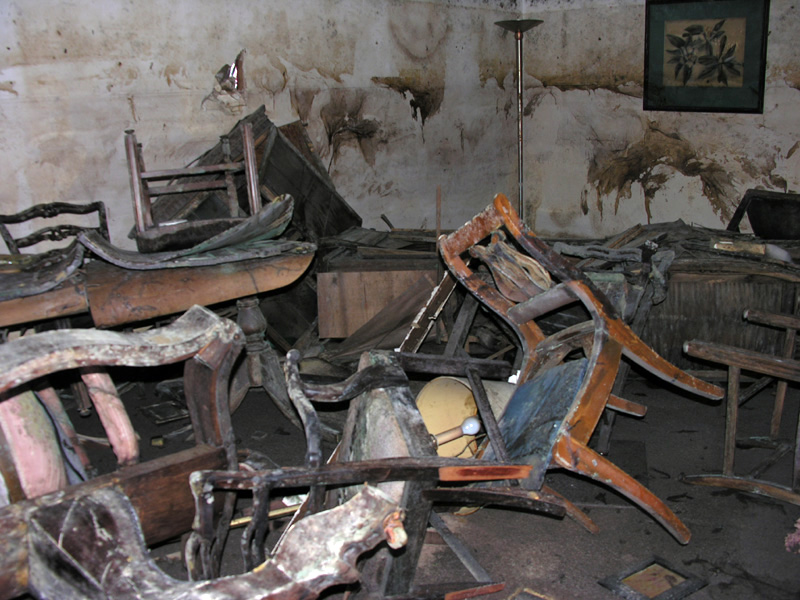
Water damage restoration cost runs about $1,300 to $6,400 for most homes, and the national average sits near $3,500.
That range is wide for a reason. A single wet closet might be a few hundred dollars, while a flooded, sewage-soaked basement can pass $20,000.
This page shows you how to find your own number on that scale, so a quote stops feeling like a random guess. If the water is still spreading, start with the first hour after a flood, then come back here.
What water damage restoration cost actually covers
The biggest reason quotes confuse people is that two different jobs get bundled into one word.
The first job is mitigation, also called dry-out. Crews extract standing water, pull soaked carpet, and run fans and dehumidifiers until the structure is dry.
Mitigation is the cheaper half, usually $3 to $7.50 per square foot of affected area.
The second job is restoration, the rebuild. New drywall, paint, flooring, and trim to put the room back the way it was.
Rebuild work is the expensive half, often $20 to $37 per square foot, because it is remodeling, not just drying.
A small clean-water leak may need only mitigation. A room that sat wet for days usually needs both, which is why those quotes jump.
Water damage restoration cost per square foot
The single biggest price lever is how dirty the water was, because dirty water means more gets thrown away instead of dried.
Restoration crews sort water into three categories, and the price climbs with each one:
- Category 1, clean water from a supply line or a rain leak: about $3 to $4 per square foot.
- Category 2, gray water from a washer, dishwasher, or overflow: about $4 to $6.50 per square foot.
- Category 3, black water from sewage or outdoor flooding: about $7 to $7.50 or more per square foot.
Black water costs more because almost everything porous it touches, carpet, pad, drywall, insulation, has to be removed and replaced rather than saved.
So a 300 square foot clean-water job might run around $1,000 to $1,200 to dry, while the same room in sewage can double or triple before the rebuild even starts.
One homeowner paid $2,500 just to tear out a two-floor ceiling leak and dry it, and wondered if that was gouging. For that scope, it lands in the normal range.
How much of the house is wet: the class of damage
Category is about how dirty the water is. Class is about how much got wet and how hard it is to dry.
This is the number that turns a small bill into a large one, and it roughly tracks like this:
- Class 1, a small area with little absorbed: about $150 to $400.
- Class 2, a whole room with wet carpet and walls: about $500 to $1,000.
- Class 3, water from above soaking ceilings and walls: about $1,000 to $3,000.
- Class 4, deep saturation in hardwood, plaster, or concrete: this is where costs run into the tens of thousands.
The higher the class, the longer the equipment runs, and how long the walls take to dry is what you are really paying for by the day.
Water damage restoration cost by area of the home
Once you know the water type and how much is wet, the location fills in the rest of the estimate.
These are common repair ranges after the water is out:
- Basement: $500 to $1,500 for an inch of clean water, and far more if it is deep or sewage.
- Ceiling: about $300 to $1,600, depending on the stain size and whether it must be opened up.
- Drywall: about $300 to $850, or roughly $1.50 to $3 per square foot to cut out and replace.
- Floors: about $200 to $550 for basic repair, more for solid wood.
- Plumbing repair behind the damage: often $1,000 to $4,000 on its own.
Wood floors are their own decision. Sometimes they dry flat and sometimes they cup for good, so read whether your hardwood floors can be saved before you agree to rip them out.
Why the same job costs more in some cities
The national average hides a real regional gap, because labor rates and demand differ by market.
Reported city averages make the spread clear:
- Denver averages around $2,470, and Salt Lake City around $2,715.
- West Palm Beach runs closer to $4,030, and Detroit around $4,040.
- Coastal California markets often sit at the high end, near $3,800 and up.
That is why a friend's bill in another state is a weak benchmark. Two or three local quotes tell you far more than any national number.
The extras that push the bill up
The line items below are where a $3,000 quote quietly becomes a $6,000 one.
Mold remediation is the big one, usually $1,100 to $3,400, and it appears whenever water sat long enough to grow it.
Equipment is billed by the day. Air movers and dehumidifiers commonly run $40 to $125 per day, each, and a job may use several.
After-hours emergency response adds a premium, and labor itself lands around $70 to $200 per hour.
If mold is already visible, do not treat it as cosmetic. It signals water sat long enough to grow, which is a real part of judging whether the remediation line is fair.

What insurance pays toward the cost
Here is the part that changes your out-of-pocket number the most: much of this is often covered.
Homeowners policies usually pay for sudden, accidental water damage, like a burst pipe or a failed water heater.
They usually do not pay for slow leaks you ignored, or for outside flooding, which needs separate flood insurance.
Because the payout is large, the paperwork matters. Photograph everything before anyone cleans, and confirm whether your policy covers a burst pipe before you file.
If the insurer pushes back, do not assume the money is gone. Know what to do if the claim is denied, because many denials get reversed.
Language matters when you report. Insurers lean on sudden versus gradual to deny, so describe an accidental event accurately and stick to the facts of what happened and when.
Is filing a claim worth the premium hit?
This is the question homeowners agonize over most: a $8,000 to $10,000 repair is real money, but so is a premium that climbs for years afterward.
First, drop the common myth. Paying cash to save your insurance for a bigger disaster is not a real thing. You stay fully covered for future catastrophes no matter what.
The genuine cost of filing is the rate increase. One homeowner watched their premium jump 40 percent after a single water claim, even with first-claim forgiveness on the policy.
That is the catch with forgiveness. It applies only at your current insurer, and it often vanishes the moment you shop a new carrier, where the claim still rates against you.
Other homeowners reported softer hits, roughly $500 a year more at renewal or about $75 a month. A water claim can also follow you for up to ten years.
Rule of thumb: file when the loss sits well above your deductible and is clearly sudden. Think twice when the repair is only a few thousand over what you would pay yourself.
Watch for padded equipment-day charges
The most common complaint homeowners share online is not the base price. It is the equipment days.
One homeowner on a personal-finance forum reported a mitigation company billing insurance $25,183 for a dry-out, with eight days charged on a job that needed about three, plus a $5,000 overhead line nobody could explain.
Most reputable companies price through Xactimate, the software insurers use, so honest quotes for the same scope land close by ZIP code.
Protect yourself with two questions: how many days will the equipment run, and what is the daily rate per machine. Ask for the moisture readings that justify each extra day.
When the insurer's offer comes in too low
Overbilling is one risk. The opposite, a lowball payout, is just as common and just as worth fighting.
Insurers often steer you to a preferred vendor. Homeowners describe these crews as chosen for cost control, not quality, and you are never required to use one.
In one case, an insurer offered about $20,000 on a hidden-leak claim, and its preferred vendor bid even lower, leaving out the subfloor and re-setting moldy cabinets.
An independent contractor priced the same job near $63,000 to $70,000. That gap was the difference between a patch and a real repair.
So the homeowner filed a complaint with the state insurance regulator. Within about ten days the claim was reassigned, re-scoped, and revised to roughly $63,000, more than triple the first offer.
Two lessons stand out. Get an independent estimate before you accept anything, and treat a regulator complaint as free leverage most people never use.
Cashing the first undisputed check does not waive your right to argue for more. If a mitigation company bills you directly, that balance is often negotiable too.
Should you DIY to save money?
For a small, clean-water spill you caught fast, a shop vacuum, fans, and a rented dehumidifier can genuinely save you the whole bill.
The trap is hidden moisture. Water wicks into wall cavities and subfloor where a homeowner cannot see or measure it.
That is how a $1,000 DIY dry-out becomes a $5,000 black mold job three months later, the outcome pros use thermal cameras and moisture meters to avoid.
DIY the small stuff. Call a pro the moment the water is dirty, has sat more than a day, or has reached finished walls.
Got a quote that feels high, or not sure whether your damage is a dry-out or a full rebuild? A quick second opinion can tell you which half of the bill you actually need.
(844) 502-1354Put it together and your estimate stops being a mystery. Water type sets the rate, the class sets the scale, location and extras fill in the rest, and insurance decides what you finally pay.
Common questions
Is it worth filing a claim for $8,000 to $10,000 of water damage?
It depends on your deductible and the premium hit. Filing makes sense when the loss sits well above your deductible and is clearly sudden. Paying cash does not save your coverage for later, so weigh the repair against a likely rate increase.
How much will my premium go up after a water damage claim?
It varies by insurer, but real homeowners report anything from about $75 a month to a 40 percent jump. A water claim can also follow you for up to ten years, so a small claim is often not worth it.
Does first claim forgiveness really protect my rate?
Not always. Several homeowners saw large increases despite forgiveness. It applies only at your current insurer and usually disappears when you switch carriers, where the claim still counts against you.
Should I use my insurer's preferred vendor for restoration?
You are never required to. Homeowners describe preferred vendors as chosen for cost control, and their bids can come in below the insurer's own offer while leaving out real scope. You can hire your own licensed contractor.
What if the insurance offer is far below my contractor's quote?
Get an independent estimate, then push back in writing. One homeowner turned a roughly $20,000 offer into about $63,000 after filing a complaint with the state insurance regulator. Cashing the first check does not waive your right to argue for more.
Do I have to pay the restoration company directly if insurance will not cover the full bill?
Emergency crews often bill you when the insurer pays less than the invoice. That balance is frequently negotiable, and in disputed cases it can be reduced or resolved once the claim is re-scoped.
Sources
- Facts + Statistics: Homeowners and renters insurance — Insurance Information Institute (Triple-I)
- ANSI/IICRC S500 Standard for Professional Water Damage Restoration — Institute of Inspection, Cleaning and Restoration Certification (IICRC)
- How Much Does Water Damage Restoration Cost? — Bob Vila
- How Much Does Water Damage Restoration Cost? (2026) — Today's Homeowner
- How Much Does Water Damage Restoration Cost? [2026 Data] — Angi
- Repair Water Damage cost guide — HomeAdvisor
- Water Damage Restoration Cost (2026 Guide) — PuroClean
- Overcharged for Water Damage (homeowner discussion thread) — Bogleheads forum
- Homeowner discussions on water claims, premiums, and payouts — Reddit homeowner discussions
 InsuranceDoes homeowners insurance cover a burst pipe?
 InsuranceYour water damage claim was denied. Here is what to do.
 EmergencyFlooded Basement? What to Do First, Hour by Hour
 Drying & RemovalHow long does it take to dry out walls after a leak?
 Materials & StructuralCan wet hardwood floors be saved?
 Mold & HealthIs black mold from water damage dangerous?