
It takes 24 to 48 hours for mold to grow after water damage, and roughly three days to three weeks before you can see it.
Those are two different clocks, and confusing them is why people relax on day three and find a problem in week three.
The spores are already in your house. Water does not import mold, it simply gives the spores already present something to eat.
So the real question is not whether mold will come. It is whether you can dry everything before the window closes.
How long does it take for mold to grow after water damage?
The EPA is direct about it. If you cannot dry wet materials within 24 to 48 hours, assume you have mold growth.
Inside that window, spores land on damp material, absorb moisture, and begin sending out hyphae, the root-like threads that start a colony.
Nothing is visible yet. The growth is microscopic for days, which is exactly why the deadline feels invented to a homeowner watching a dry-looking floor.
Visible colonies typically appear between 3 and 21 days. In a saturated space with soaked porous material, growth can show in 48 to 72 hours.
One honest caveat. The 24 to 48 hour figure is a practical drying benchmark, not a guarantee, and the EPA notes mold can occur even when you dry quickly.
If the water is still there, stop reading and start extracting. The ordered emergency steps are in what to do first when a space floods.
What causes mold to grow after water damage
Mold needs four things, and a wet house hands it all four at once.
- Moisture. Materials above roughly 16 to 20 percent moisture content, or air above 60 percent humidity.
- Food. Cellulose. Drywall paper, wood, cardboard, carpet backing, dust.
- Temperature. Roughly 60 to 80 degrees, the same range you keep your house in.
- Time. A day or two of the first three together.
You cannot remove the food or the temperature. Moisture is the only variable you control, which is the entire logic of restoration.
Poor airflow accelerates it. A closed cabinet, a wall cavity, or the space under carpet pad holds humid still air, which is why hidden mold beats visible mold to the start.
Dirty water starts faster too. Sewage and flood water arrive carrying nutrients and bacteria that clean supply water does not.
How long for mold to grow after water damage on drywall, wood, and carpet
The timeline changes with what got wet, so here is the practical order.
Paper-faced drywall: 24 to 48 hours. The paper facing is pure cellulose and holds water against itself. This is almost always first.
Carpet pad and carpet backing: 24 to 48 hours. The pad acts as a sponge and the carpet above it traps the moisture in.
Insulation: 48 to 72 hours. Wet fiberglass stays wet for weeks and sits directly against framing and drywall.
Wood framing and subfloor: 3 to 7 days. Slower to start, but it holds moisture long enough to sustain growth once it does.
Books, paper, and upholstery: 24 to 48 hours. Porous, cellulose rich, and rarely dried properly.
Concrete, tile, and metal: much slower. Mold cannot eat them, though it happily grows in the dust and adhesive on top.
That ordering is why crews pull pad and cut drywall early. Whether wet drywall has to be replaced is mostly a question of how many hours it stayed wet.
Where it starts, and why you will not see it
Mold begins in the places with moisture, food, and no air movement, which is almost never the middle of the floor.
- Inside wall cavities, on the back of the drywall where nobody looks.
- Under carpet pad and along the tack strip.
- Behind baseboards and inside the cabinet toe kick.
- Under vinyl plank or laminate, where water sits on the subfloor.
- In the HVAC system, if wet air was circulated through the ducts.
This is why a room can look and feel dry while a colony is weeks into its life six inches away behind the wall.
Surfaces dry first and cavities dry last. Read how long walls actually take to dry before you decide the job is finished.
Signs mold has already started
The first sign is almost never visual. It is a musty, earthy smell that gets stronger in a closed room.
That odor is a byproduct of active growth, so if you can smell it, the colony is established, not starting.
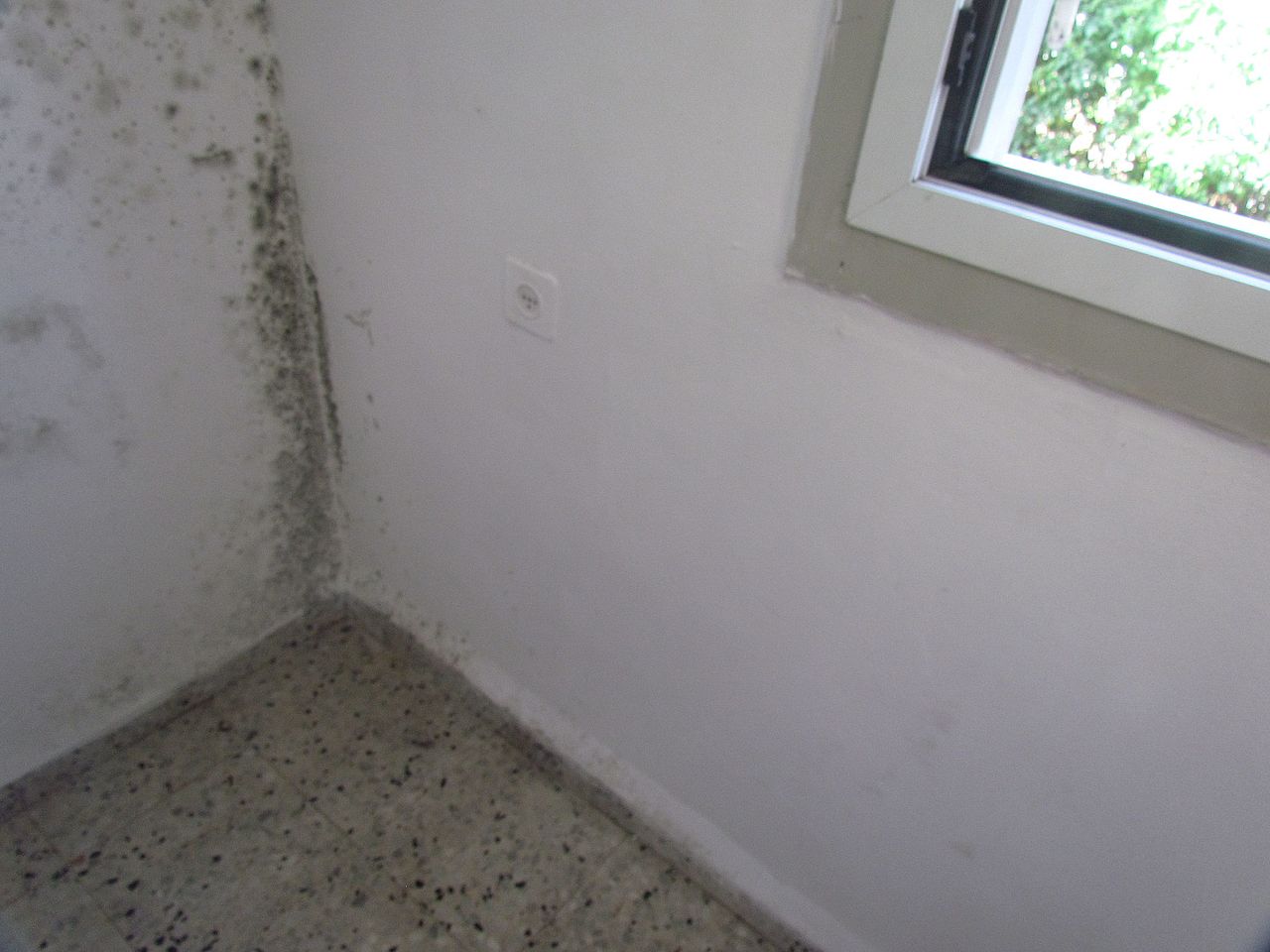
Other early signals: dark speckling on drywall paper, a fuzzy bloom on wood, staining that spreads at the edges, and paint that bubbles weeks after the leak.
Symptoms count too. Congestion, coughing, or itchy eyes that improve when you leave the house point at the house, not at allergies.
Color tells you very little. Whether black mold from water damage is dangerous is a fair question, but any indoor growth needs removing regardless of shade.
How fast it spreads once it starts
Growth does not stay where the water was. A colony releases spores continuously, and they travel on ordinary household air currents.
In a house with the HVAC running, spores from a wet basement reach every room within days, settling wherever they find dust and dampness.
That is why restoration crews build containment before they cut anything, and why running a box fan across visible mold is the worst thing you can do.
Colony size roughly follows the moisture. As long as the material stays above the threshold, the patch keeps expanding at its edges.
Dry it out and growth stops, but the dead material does not disappear. Dried mold still releases allergens, so it has to be removed, not just dried.
Why season and room temperature move the clock
The 24 to 48 hour figure assumes a normal indoor environment, and your house is not always that.
Summer. Warm, humid air slows evaporation and speeds growth, so the window is at its tightest in July and August.
Winter. Cold framing and dry indoor air can stretch the timeline, but unheated crawl spaces and garages stay damp far longer.
Closed-up houses. A vacation home or vacant rental with no air movement is the fastest case of all, because nothing disturbs the damp air.
Keep this in mind if the leak happened while you were away. The relevant clock started when the water did, not when you walked in.
How to beat the 48 hour window
Prevention is one thing only: get it dry, fast. Everything else is theater.
- Extract standing water immediately with a wet vac or pump. Liquid removed is water nobody has to evaporate.
- Pull carpet pad and wet insulation out. Neither dries in place, and both feed growth.
- Open the cavities. Remove baseboards, and cut drywall if the water sat.
- Run air movers and a dehumidifier continuously, not just fans.
- Hold humidity under 60 percent, the level the EPA names for suppressing mold in a home.
Skip the bleach. It does not penetrate porous material, and spraying a wet wall adds water to the exact problem you are trying to remove.
The full sequence a crew follows is worth understanding: how the professional drying process works, including how they prove it is dry.
Do you need a mold test?
Usually not. Both the EPA and the CDC take the same position: if you can see or smell mold, testing does not change what you do next.
You remove it and you fix the moisture, and no lab result alters either step.
Testing earns its cost in three situations: a dispute with a landlord or insurer, a health complaint with no visible source, or verification after a large remediation job.
What is worth paying for is a moisture inspection. A technician with a meter and a thermal camera finds the wet cavity, which is the thing that actually matters.
Be careful with mail-in air sample kits. Spores are present in every indoor environment, so a positive result on its own proves very little.
What if it has already been more than 48 hours?
Then you plan for mold instead of racing it, and the job changes from drying to removal.
Assume growth in porous materials that stayed wet, and stop running fans across visible mold, because that spreads spores through the house.
The EPA uses a rough line of about 10 square feet. Smaller patches on hard surfaces a homeowner can clean, larger areas need containment.
Cleaning method matters more than product: how to get rid of mold after water damage covers what to remove and what can be saved.
And if the smell keeps coming back after everything looks clean, the moisture source is still there. Odor that returns is a leak you have not found.
Past the 48 hour mark with wet walls? A moisture reading tells you what you are dealing with before the drywall does.
(844) 502-1354Common questions
Can mold grow in 24 hours?
Yes. Germination can begin within 24 hours on damp cellulose materials like drywall paper and carpet backing, which is why the EPA treats 24 to 48 hours as the drying deadline. You will not see anything at that stage, because early growth is microscopic.
How long before I can actually see the mold?
Usually 3 to 21 days. In heavily saturated conditions with soaked porous materials, visible colonies can appear in 48 to 72 hours. By the time you can see it, the colony has been growing for days, so visible mold is never the start of the problem.
The area dried out on its own. Am I safe?
Only if it dried fully within about 48 hours, including inside walls and under flooring. Surfaces dry far faster than cavities, so a room that feels dry can sit above wet framing for a week. A moisture meter reading is the only reliable answer.
Does mold always grow after water damage?
No. The EPA notes that growth is not guaranteed even past 48 hours, and clean water dried quickly on non-porous surfaces often causes no problem at all. The 24 to 48 hour rule is a planning benchmark, not a biological certainty.
Will running the air conditioner or a fan stop mold?
Fans help only while materials are still drying, and they help far less than extraction plus a dehumidifier. Once mold is visible, blowing air across it spreads spores through the house and makes the cleanup larger, so stop the fans at that point.
Does bleach prevent mold after a leak?
Not on porous materials. Bleach is mostly water, it does not penetrate drywall or wood, and it leaves moisture behind after the chlorine evaporates. Drying the material and removing what cannot be dried is what actually prevents growth.
Sources
- A Brief Guide to Mold, Moisture and Your Home — U.S. Environmental Protection Agency
- Mold Cleanup After a Flood — U.S. Centers for Disease Control and Prevention (CDC)
- Mold Course, indoor mold growth and moisture control — U.S. Environmental Protection Agency
- ANSI/IICRC S520 Standard for Professional Mold Remediation — Institute of Inspection, Cleaning and Restoration Certification (IICRC)
- Basic Facts about Mold and Dampness — U.S. Centers for Disease Control and Prevention (CDC)
- Mold growth timeline after water damage — PuroClean restoration network
- Dampness and Mould, health guidance for indoor air — World Health Organization (WHO)
 Mold & HealthHow to get rid of mold after water damage
 Mold & HealthIs black mold from water damage dangerous?
 Drying & RemovalHow long does it take to dry out walls after a leak?
 AftermathHow to get rid of a musty smell after water damage
 Drying & RemovalHow professional water damage drying works
 MaterialsWet carpet after water damage: can it be saved?